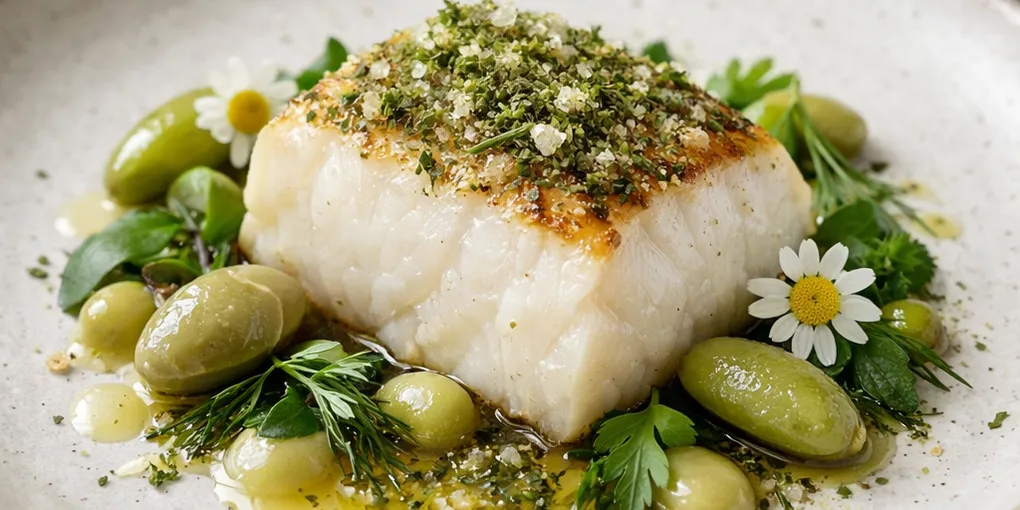
Chamomile-Smoked Halibut with Pickled Green Almonds & Pine-Needle Salt
Chamomile-Smoked Halibut with Pickled Green Almonds & Pine-Needle Salt
A refined plate that balances delicate white fish with an unexpected floral-smoke and crunchy, tart pickled green almonds. The secret twist: a short chamomile smoke under a cloche and a finishing sprinkle of toasted pine-needle salt — floral, resinous and utterly addictive.
Yields: 4 servings
Total time: 1 hour 20 minutes (plus 2–24 hours for pickles, optional)
Skill level: Advanced home cook / professional
Why this works (Chef’s note)
- Chamomile smoke lifts and sweetens the halibut without overpowering it — think of it as a floral signature instead of common wood smoke.
- Pickled green almonds provide a crunchy, almond-bright acidity that cuts the butteriness of the fish.
- Brown-butter saffron pearls (easy quenelle/pipe technique) deliver small bursts of luxurious mouthfeel.
- Pine-needle salt is the finishing punctuation: aromatic, forest-like, and unexpectedly complementary to seafood.
Ingredients
For the halibut
- 4 halibut fillets (5–6 oz / 150–175 g each), skin off, thickness even
- 2 tbsp neutral oil (grapeseed or avocado)
- Kosher salt and freshly ground black pepper
For chamomile smoke
- 2 tbsp dried chamomile flowers (culinary grade)
- 1 small wad of wood chips (apple or alder), optional (for depth)
- 1 metal sieve or small grill pan
- Heatproof glass cloches or large overturned mixing bowls
Pickled green almonds (quick pickle — can be made 2–24 hrs ahead)
- 100 g (about 1 cup) fresh green almonds, peeled (or young blanched almonds if unavailable)
- 120 ml (½ cup) white wine vinegar
- 120 ml (½ cup) water
- 1 tbsp sugar
- 1 tsp kosher salt
- 1 small garlic clove, smashed
- 1 small sprig thyme
Brown-butter saffron pearls
- 90 g (6 tbsp) unsalted butter
- Pinch of saffron threads, steeped in 1 tbsp hot water
- 1 tsp lemon juice
- Salt to taste
- Optional: 1 g soy lecithin or 1 tsp gelatin (for more stable pearls; see technique notes)
Pine-needle salt
- 3 tbsp flaky sea salt (Maldon or similar)
- 2 tbsp finely chopped dried pine needles (culinary grade; Scots pine, not sap/resin)
- 1 tsp lemon zest
Garnish & plating
- 1 small bunch sorrel or baby watercress
- 1 charred spring onion or a few charred leek petals
- Extra toasted almond slivers (optional)
- Micro herbs (optional)
Equipment notes
- Heavy skillet (cast iron recommended)
- Small smoker method: a metal sieve or smoking box and a heatproof cloche/glass bowl
- Small saucepan for brown butter
- Fine mesh sieve
- Blender or mortar for pine-needle salt
- Spoons, piping bag or small scoop for saffron pearls
Method
1 — Make the quick pickled green almonds
- Combine vinegar, water, sugar, and salt in a saucepan and bring to a simmer to dissolve sugar and salt. Cool slightly.
- Place green almonds, smashed garlic and thyme in a sterilized jar. Pour in brine to cover. Let cool to room temp, then refrigerate. Minimum 2 hours; best after 12–24 hours. (If you can’t find green almonds, use very young blanched almonds.)
2 — Prepare the pine-needle salt
- Dry the pine needles completely (low oven at 80°C / 175°F for 20–30 min if needed).
- Grind dried needles in a spice grinder or mortar until very fine. Mix with flaky sea salt and lemon zest. Store in an airtight jar. Makes more than needed — keeps for weeks.
3 — Brown-butter saffron pearls (the creamy surprise)
- In a small saucepan, melt butter over medium heat. Swirl until it turns golden-brown and gives a nutty aroma — about 4–6 minutes. Watch closely; brown to deep nutty but don’t burn.
- Remove from heat; whisk in saffron water, lemon juice and salt. Strain through a fine sieve into a bowl and chill until slightly thickened (20–30 minutes).
- For pearls: refrigerate until firm enough to scoop into small quenelles, or transfer to a piping bag and pipe tiny dollops onto a tray, then chill until set. Optional: whisk in 1 g soy lecithin and aerate lightly to make a more stable foam/pearls, or dissolve 1 tsp gelatin in 2 tbsp warm water and emulsify into the butter for a firmer bead.
4 — Prep halibut
- Pat fillets dry. Season lightly with salt and pepper.
- Heat skillet over medium-high and add neutral oil. Sear fillets 1.5–2 minutes per side (depending on thickness) for a golden crust and tender, opaque center. Remove and rest briefly.
5 — Chamomile smoke finish (the secret twist)
- Place a metal sieve in a second pan. Scatter chamomile flowers and a few wood chips (if using) over the hot pan and ignite briefly until fragrant smoke starts. Immediately position the halibut fillets on a heatproof tray. Invert a heatproof glass cloche or bowl over the fish to trap the chamomile smoke for 1–2 minutes.
- Remove cloche and serve immediately. The smoke duration is short — you want a delicate floral veil, not heavy smoke.
6 — Charred leek petals (quick garnish)
- Halve a spring onion lengthwise or separate leek into thin strips. Char in the hot pan with a drizzle of oil until lightly blackened, about 30–60 seconds per side. Set aside.
Plating (assembly)
- Spoon a small smear of chilled brown-butter saffron onto each plate or arrange tiny quenelles/pearls in clusters around where the fish will sit.
- Place the halibut fillet gently in the center.
- Scatter 6–8 pickled green almonds around the fish for crunch and acidity.
- Add charred leek petals and a few sorrel leaves.
- Finish with a light dusting of pine-needle salt — use very sparingly; it’s intensely aromatic. Add toasted almond slivers or micro herbs if desired. Serve immediately.
Technique tips & troubleshooting
The secret twist: chamomile smoke
- Use culinary-grade chamomile (dried tea flowers). The smoke is extremely delicate — trap it for only 60–120 seconds. Longer will overwhelm.
- If you don’t have a cloche, invert a large stainless bowl; pull it up slowly while the smoke dissipates to let the aromas mingle before serving.
Saffron pearls stability
- If you want the beurre to hold shape at room temperature, add a minimal amount of gelatin (1 tsp dissolved in 2 tbsp water), whisk into warm brown butter off heat, then chill. For a lighter texture, use lecithin and make tiny aerated spheres.
Pickled green almonds
- If true green almonds are unavailable, use very young marcona almonds lightly blanched; texture won’t be identical but will keep the crunchy-acid counterpoint.
Pine-needle salt safety
- Use culinary-grade pine needles only. Avoid resinous sap and do not use unknown conifers. Scots pine, spruce or culinary pinus varieties are suitable. Always dry before grinding.
Make-ahead & storage
- Pickled almonds: keep refrigerated up to 2 weeks.
- Pine-needle salt: airtight up to 6 months.
- Brown-butter saffron: refrigerated up to 3 days; bring back to slightly cool, spoonable temperature before plating.
- Best to smoke and sear halibut right before service for texture and aroma.
Wine & beverage pairing
- White: A crisp, herbal Albariño or a nervy Chablis — acidity to cut butter and complement chamomile floral tones.
- Rosé: Dry Provençal rosé for a light, fruity lift.
- Non-alcoholic: Sparkling water with a lemon twist or a chilled chamomile + apple shrub (to echo the floral note).
Variations
- Substitute halibut with cod, sea bass or thick scallops — adjust sear time.
- Make it vegetarian: pan-seared king oyster mushroom slices (thick “scallops”) smoked the same way.
- Swap saffron pearls for a lemon-anchovy beurre if you prefer less luxury and more umami.
Final chef tips
- Be bold but precise with the chamomile: it is the defining accent. A whisper is better than shouting.
- Balance crunchy, acidic, and buttery elements on each bite — that contrast is what will make guests say “wow.”
- Label your pine-needle salt and store separately — a little goes a long way.
If you make this, please tell me how the chamomile smoke landed — it’s the element that surprises even seasoned diners. Enjoy the floral-smoke ride.